In full-year 2025, Mercedes-Benz worldwide sales were 10% lower, but global AMG and G-Class model deliveries increased.
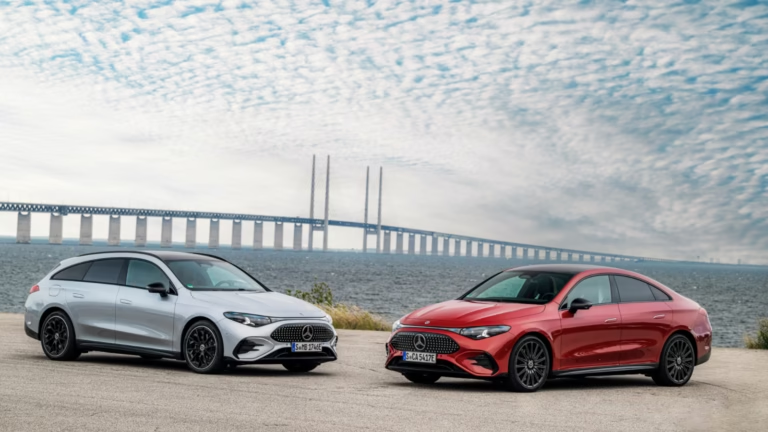
2025 (January to December): Mercedes-Benz Cars sold 1,800,800 million passenger cars (-9%) worldwide and 359,100 vans (-11%). Globally, Mercedes-Benz Group sales were down 10% to 2,160,000 vehicles. Mercedes-AMG deliveries increased 7% and the G-Class had record sales. Battery-electric vehicle (BEV) sales generally outperformed the rest of the group’s sales worldwide during the final quarter of the year with strong growth in electric car sales expected in 2026.
Mercedes-Benz Group Sales Worldwide in 2025
Mercedes-Benz Group vehicle sales worldwide in 2025 were as follows:
| FY 2025 | Change 2024 | |
| Mercedes-Benz Group | 2,160,000 | -10% |
| – thereof BEVs | 197,300 | -4% |
| Mercedes-Benz Cars | 1,800,800 | -9% |
| – thereof BEVs | 168,800 | -9% |
| Mercedes-Benz Vans | 359,100 | -11% |
| – thereof eVans | 28,500 | +46% |
Mercedes-Benz Car Worldwide Sales by Model Segment in 2025
Mercedes-Benz global sales by car model segment were as follows in 2025:
| Model Segment | Sales 2025 | % Change |
| Top-End | 268,000 | -5% |
| Core | 1,049,600 | -10% |
| Entry | 483,300 | -10% |
* Top-End: Mercedes-AMG, Mercedes-Maybach, G-Class, S-Class, GLS, EQS and EQS SUV.
* Core: All derivatives from C- and E-Class, incl. EQC, EQE and EQE SUV.
* Entry: All derivatives from A- and B-Class incl. EQA, EQB and smart.
Top-End Vehicle sales in 2025 reached 268,000 units, representing a 15%-share of overall sales. Mercedes‑AMG achieved one of the best sales results in its history with 145,000 performance vehicles (+7%) delivered to customers in 2025.
Furthermore, the success story of the Mercedes-Benz off-road icon G-Class continues with best-ever sales in 2025, reaching 49,700 customer deliveries (+23%) and sales growth in all key regions. The electric G-Class has substantially contributed to this sales performance, attracting an expanded customer base.
Mercedes-Maybach demonstrated its resilience in 2025 with a growing sales share of the S-Class. Every third S-Class sold in 2025 was a Mercedes-Maybach model, and in China, even every second.
Mercedes-Benz Sales by Country or Region in 2025
Mercedes-Benz sales in major countries and large global markets were as follows in 2025
| Market | Sales 2025 | % change |
| Europe | 634,600 | -1% |
| – thereof Germany | 213,200 | 0% |
| Asia | 747,000 | -16% |
| – thereof China | 551,900 | -19% |
| North America | 320,600 | -12% |
| – thereof U.S. | 284,600 | -12% |
| Rest of World | 98,700 | +17% |
In 2025, Mercedes-Benz Passenger Cars achieved sales growth in European markets such as Germany (+1%, excluding smart), Spain (+6%) and Poland (+6%), as well as other important markets such as South America (+54%), Australia (+10%), Turkey (+11%) and the Gulf States (+3%).
In the U.S. market, tariffs and diligent stock management impacted group sales in 2025. However, deliveries to customers increased by 1% in the U.S. market.
In a competitive market environment in China, Mercedes-Benz sales volumes were sharply down. However, in 2025, Mercedes-Benz retained its leading market share in the segment priced 1 million RMB and above in China. Half of all S-Class cars sold in China were the expensive Maybach version.
Global Worldwide Car Sales by Brand in 2025 (Full Year)
- → Global Worldwide Car sales by Brand in 2025, 2024, 2023, 2022, 2021, 2020
- → USA Car Sales by Brand in 2025, 2024, 2023, 2022, 2021, 2020, 2019, and 2018
Global worldwide sales by brand in 2025:
- Audi
- BMW
- BYD
- Cupra (Seat)
- Kia
- Lamborghini
- Lexus
- Mazda
- Mercedes-Benz
- Mini (BMW)
- Nissan
- Porsche
- Rolls-Royce (BMW)
- Seat (Cupra)
- Tesla
- Toyota (incl. Lexus)
- Volkswagen (VW Brand)
- Volvo
*NOTE: Car sales as reported by the respective car brands. “Sales” often refers to deliveries rather than sales and final registrations by the end consumer. Definitions may vary.
About Mercedes-Benz AG
Mercedes‑Benz AG is part of the Mercedes‑Benz Group AG with a total of around 175,000 employees worldwide and is responsible for the global business of Mercedes‑Benz Cars and Mercedes‑Benz Vans. Ola Källenius is Chairman of the Board of Management of Mercedes‑Benz AG.
The company focuses on the development, production and sales of passenger cars, vans and vehicle-related services. Furthermore, the company aspires to be the leader in the fields of electric mobility and vehicle software. The product portfolio comprises the Mercedes‑Benz brand with Mercedes‑AMG, Mercedes‑Maybach and G‑Class with their all-electric models as well as products of the smart brand. Mercedes‑Benz AG is one of the world’s largest manufacturers of high-end passenger cars. In 2024 it sold around 2,4 million passenger cars and vans. In its two business segments, Mercedes‑Benz AG is continually expanding its worldwide production network with more than 30 production sites on four continents, while gearing itself to meet the requirements of electric mobility. At the same time, the company is constructing and extending its global battery production network on three continents. As sustainability is the guiding principle of the Mercedes‑Benz strategy and for the company itself, this means creating lasting value for all stakeholders: for customers, employees, investors, business partners and society as a whole. The basis for this is the sustainable business strategy of the Mercedes‑Benz Group.